EMPIRICUS, Sextus.
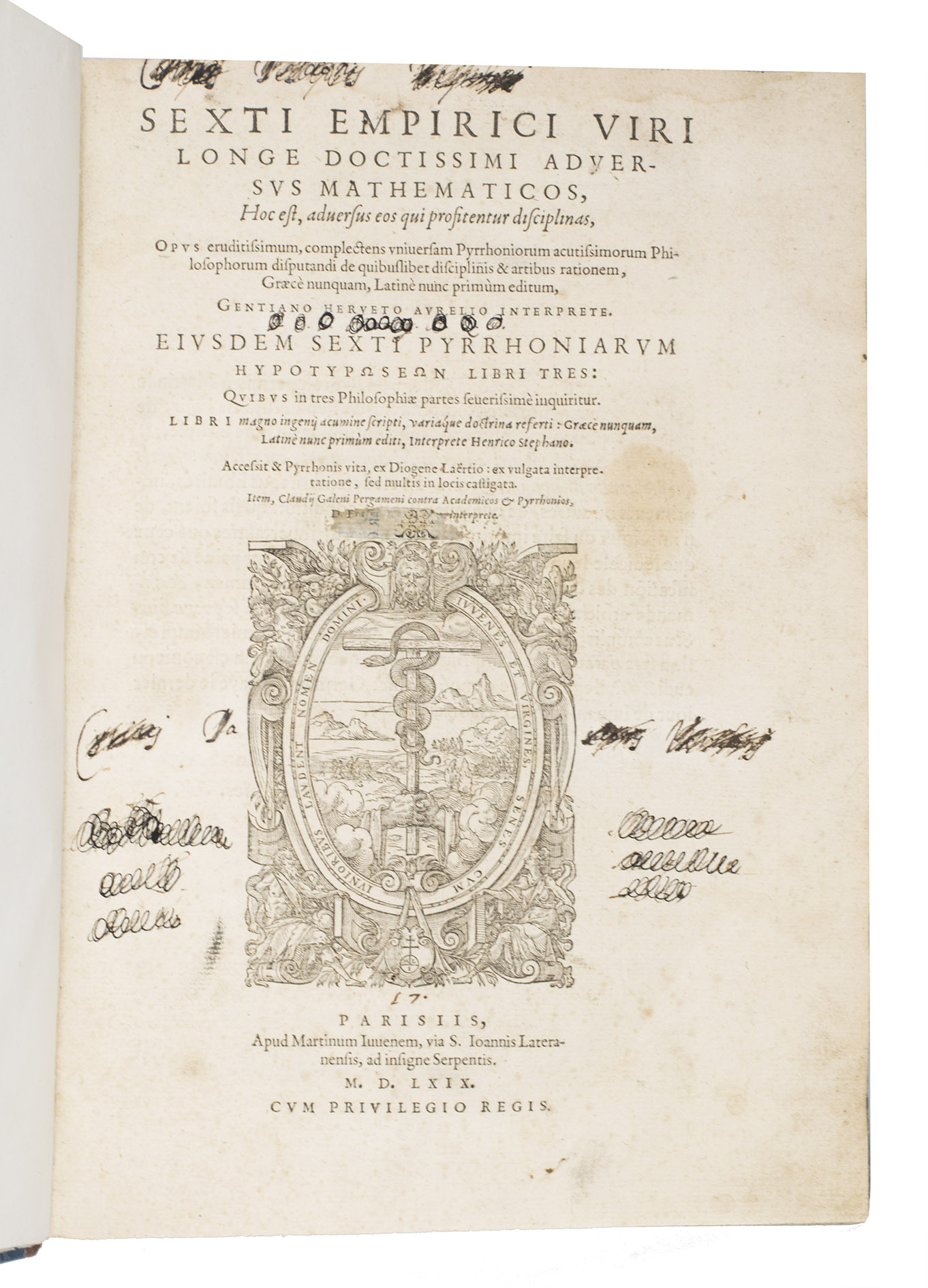
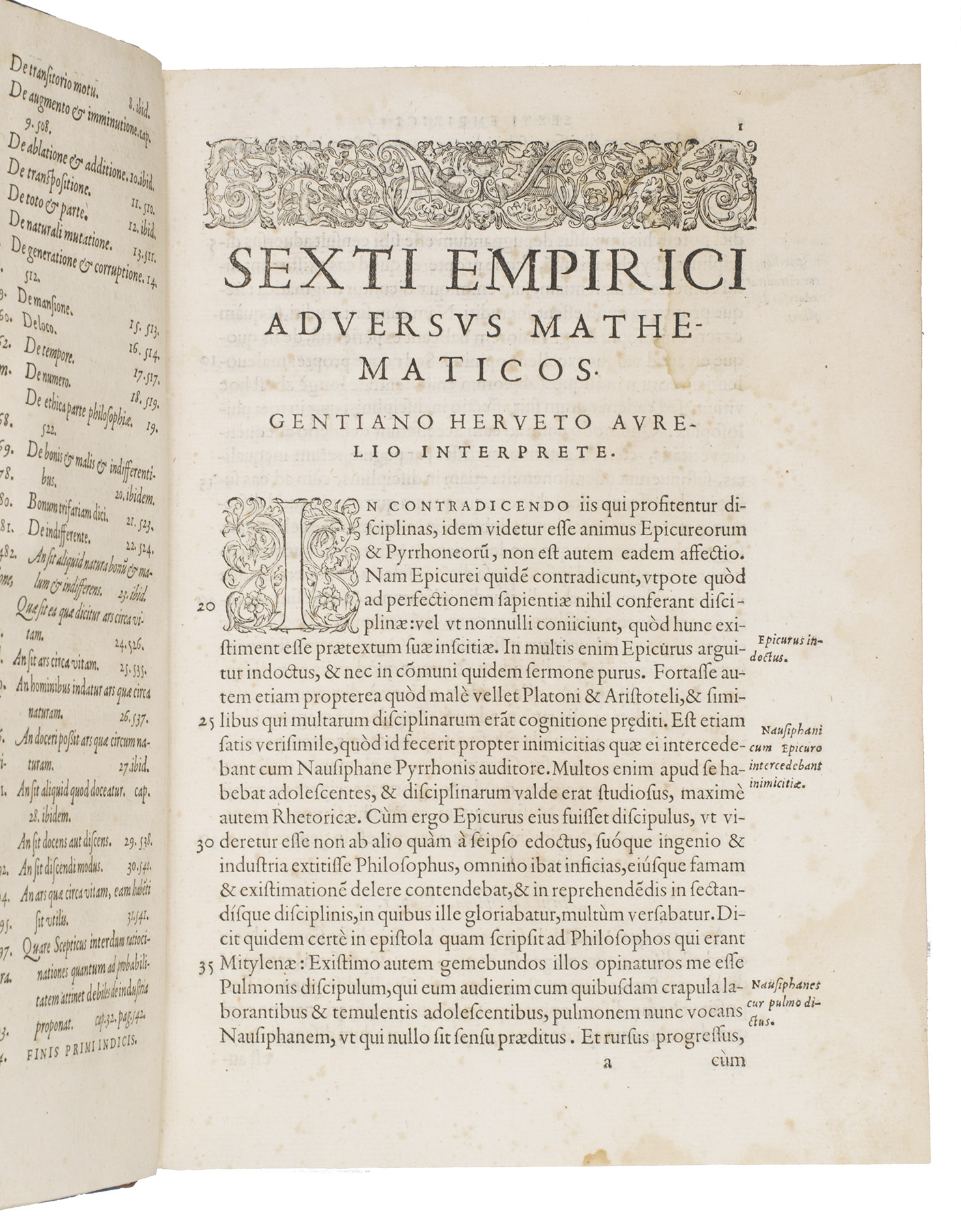
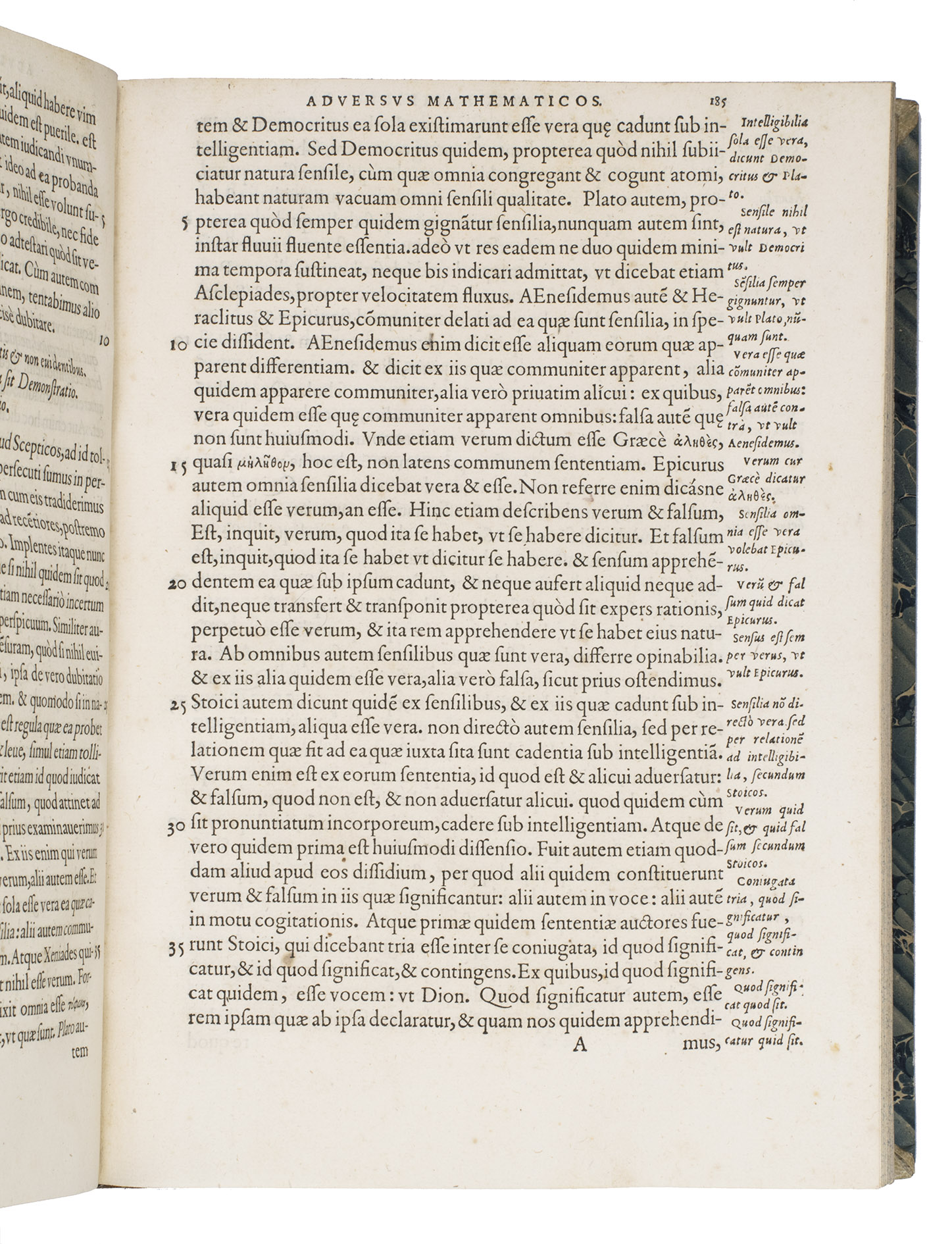
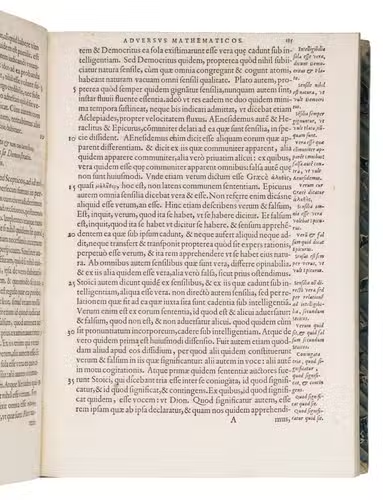
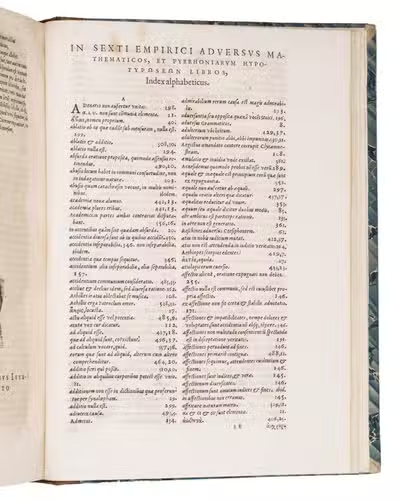
Adversus Mathematicos ... Opus eruditissimum, complectens universam Pyrrhoniorum acutissimorum Philosophorum disputandi de quibuslibet disciplinis & artibus rationem, Graecè nunquam, Latinè nunc primùm editum, Gentiano Herveto Aurelio interprete. Eiusdem Sexti Pyrrhoniarum Hypotypooseoon libri tres ... Graecè nunquam, Latinè nunc primùm editi, Interprete Henrico Stephano. Accessit & Pyrrhonis vita, ex Diogene Laërtio ... Item, Claudii Galeni Pergameni contra Academicos et Pyrrhonios, D[esiderio] Erasmo Roterodamo interprete.
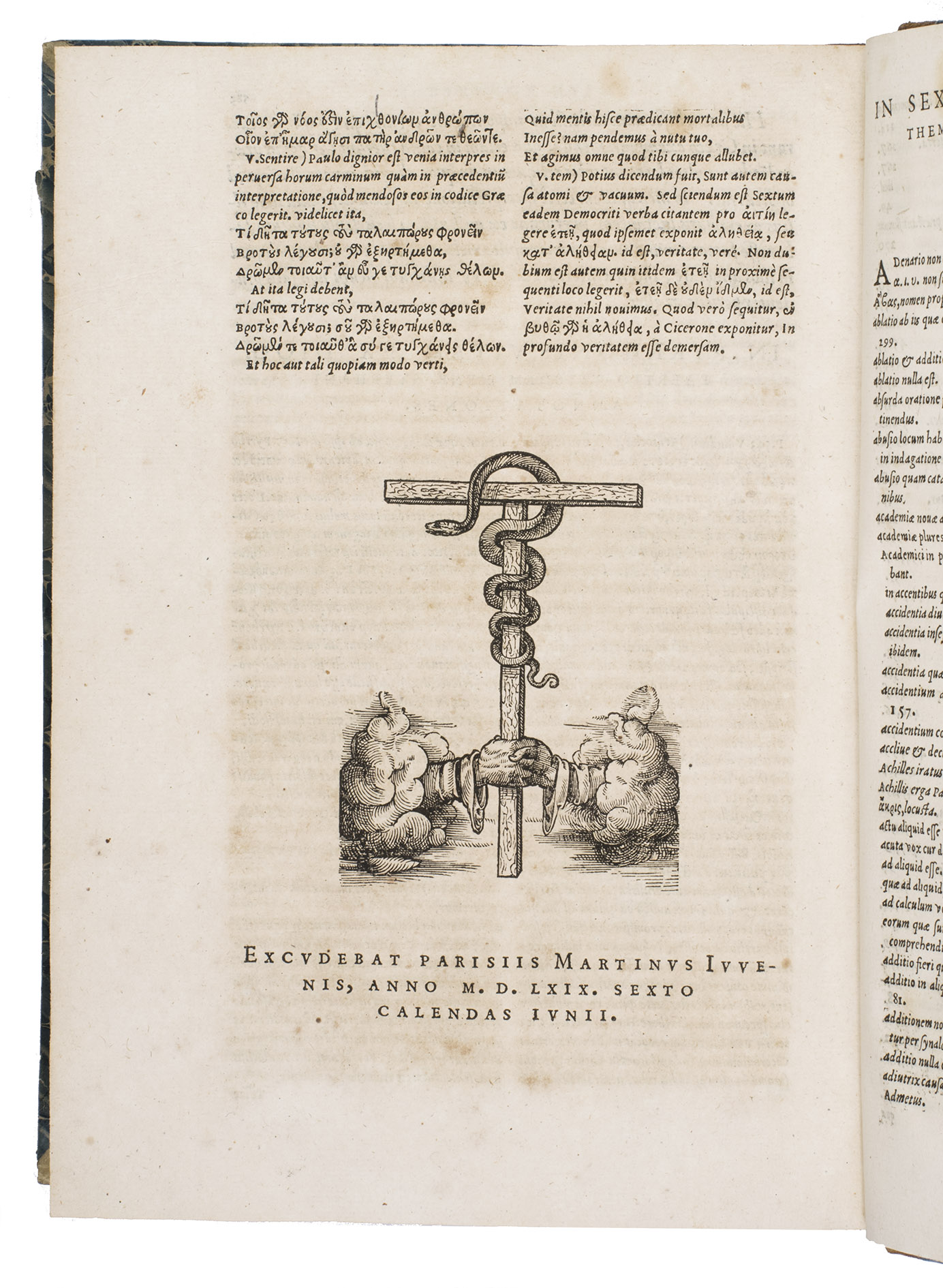
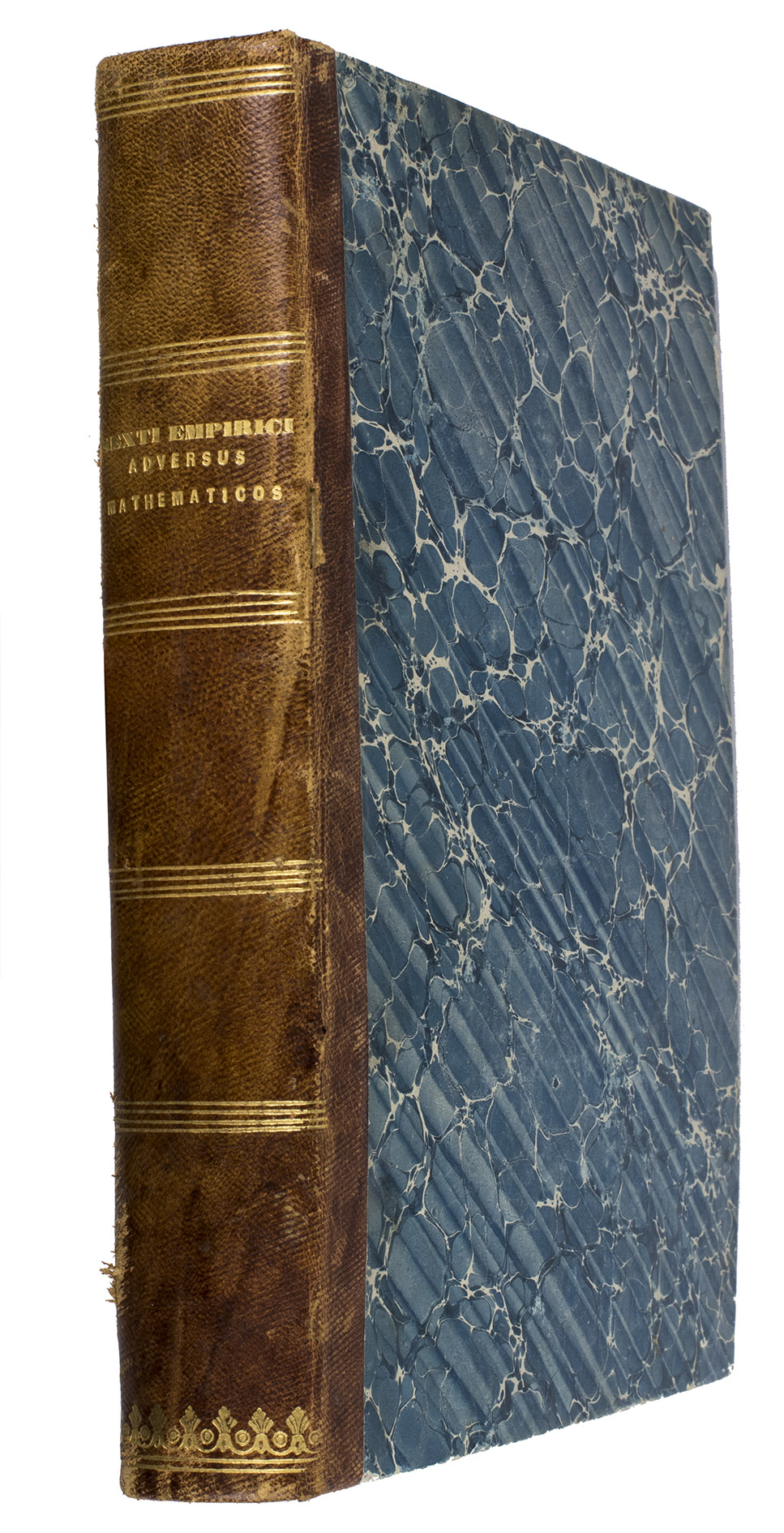
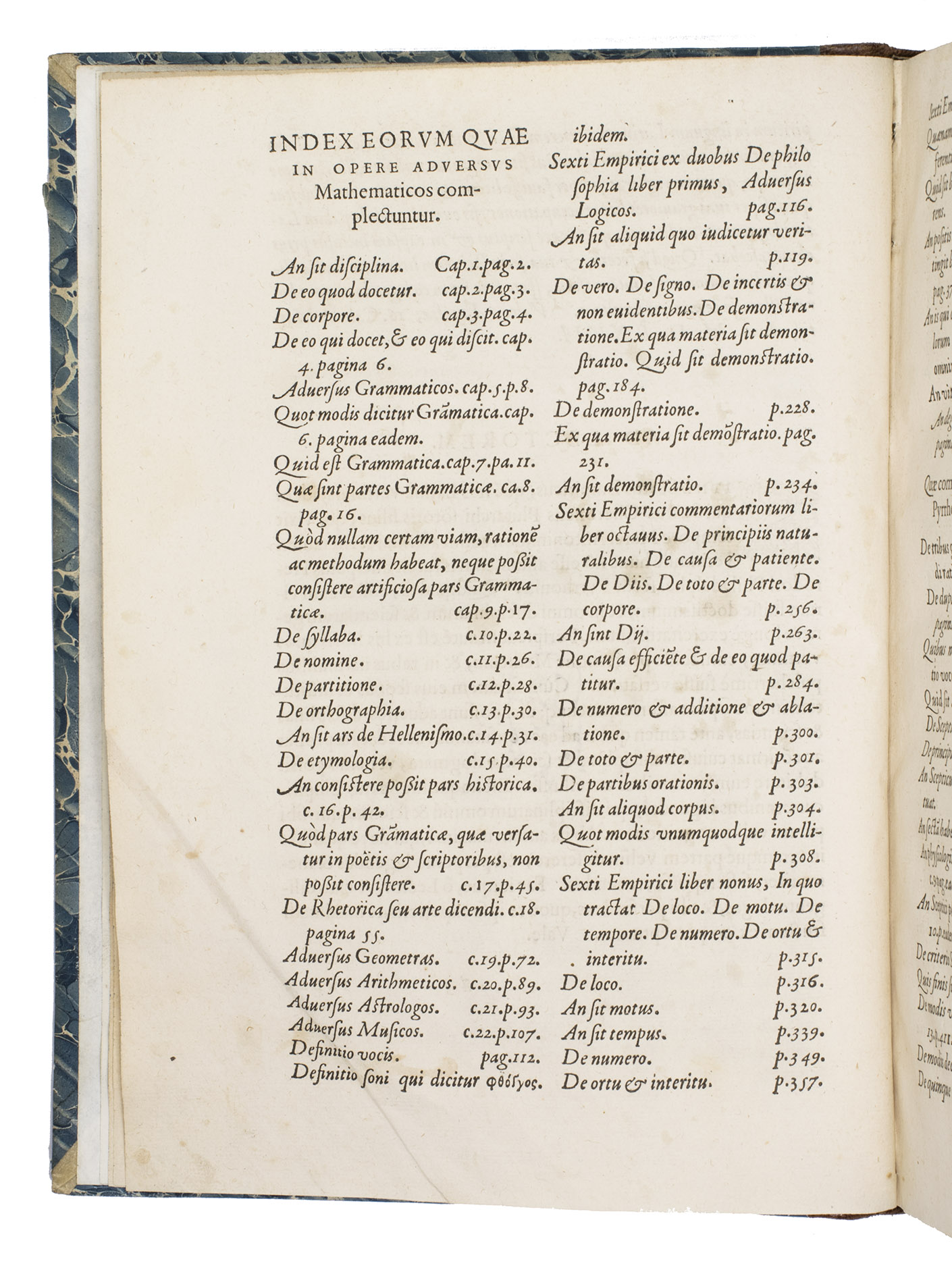
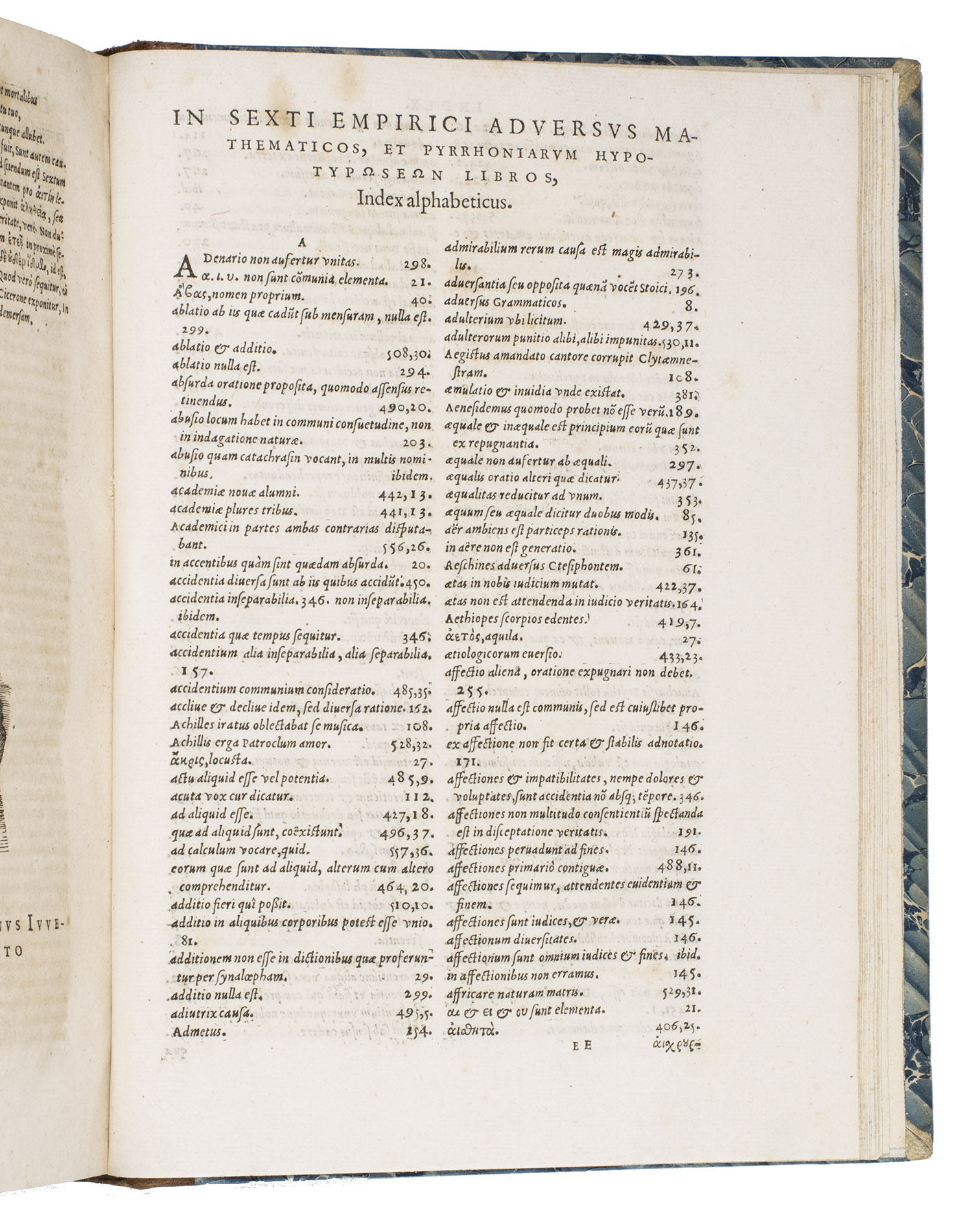
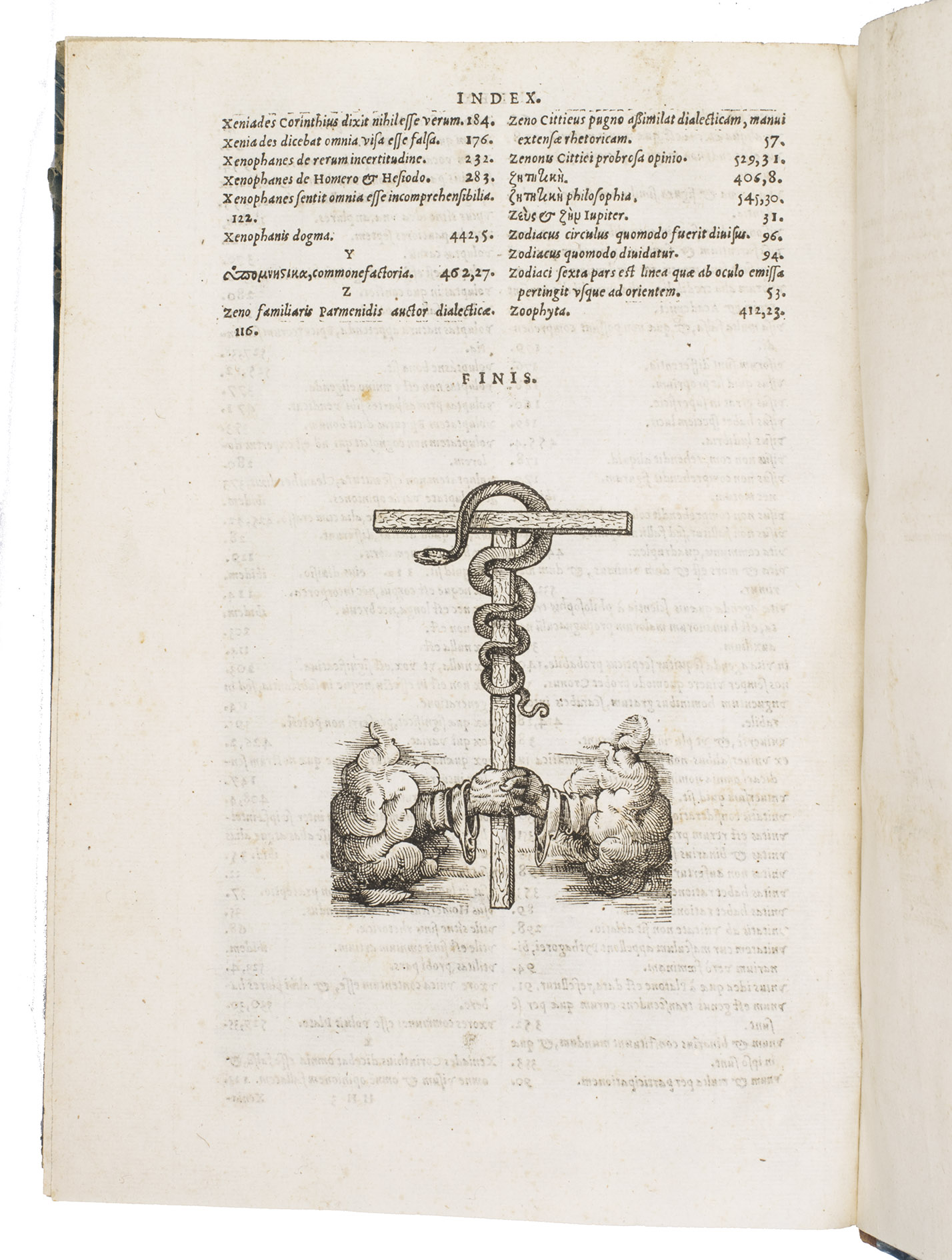
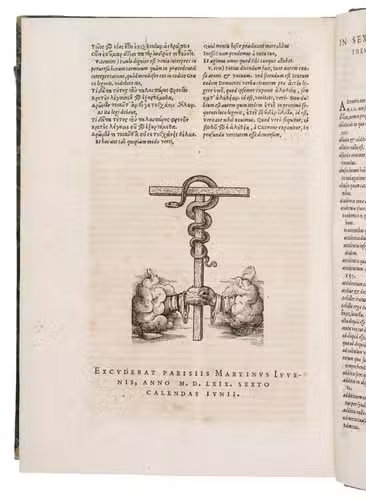
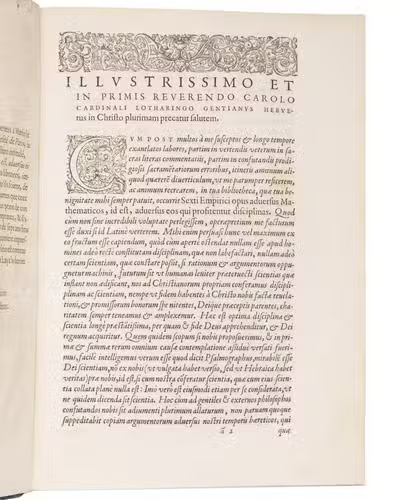
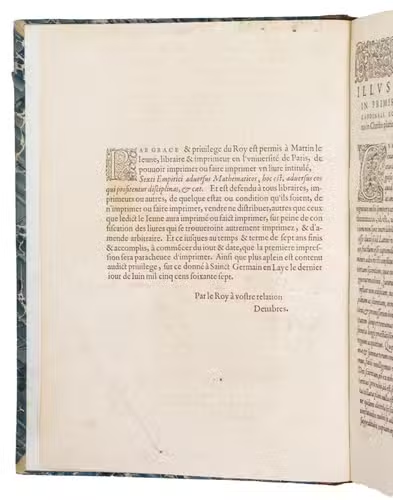
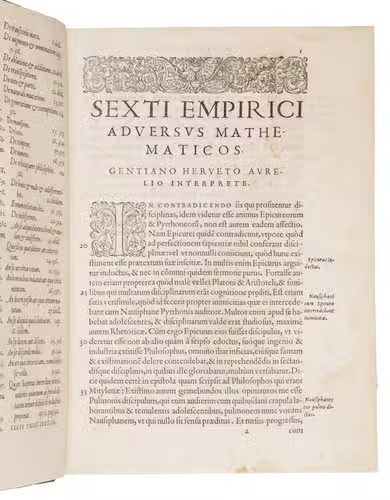
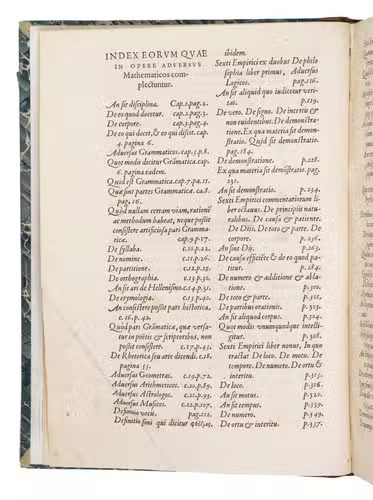
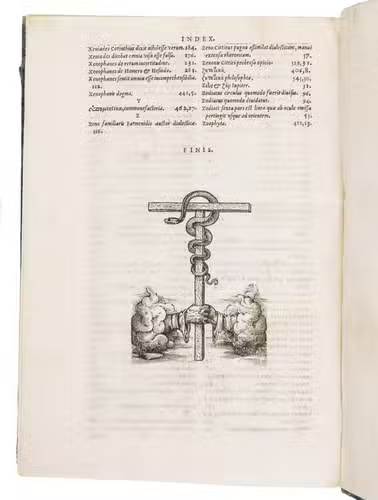
Paris, Martin Le Jeune, 27 May 1569. 2 parts in 1 volume. Folio. With a woodcut printer's device on the title pages of both parts, at the end of the second part (p. 584) and at the end of the index, further with several decorated woodcut initials and woodcut headpieces. 19th-century gold-tooled quarter calf. [8], 584, [32] pp.
€ 4,500
First collected edition of the works of Sextus Empiricus (fl. late second or early third century CE), the only Pyrrhonian philosopher of antiquity whose writings have survived. As the principal source for the ancient school of philosophical scepticism, his works sparked a revival of Pyrrhonism following their rediscovery in the 15th century and profoundly influenced early modern thought, leaving their mark on philosophers as Montaigne, Descartes, and Pascal. They also preserve numerous quotations from otherwise lost authors and remain an indispensable source for the reconstruction of Stoic logic.
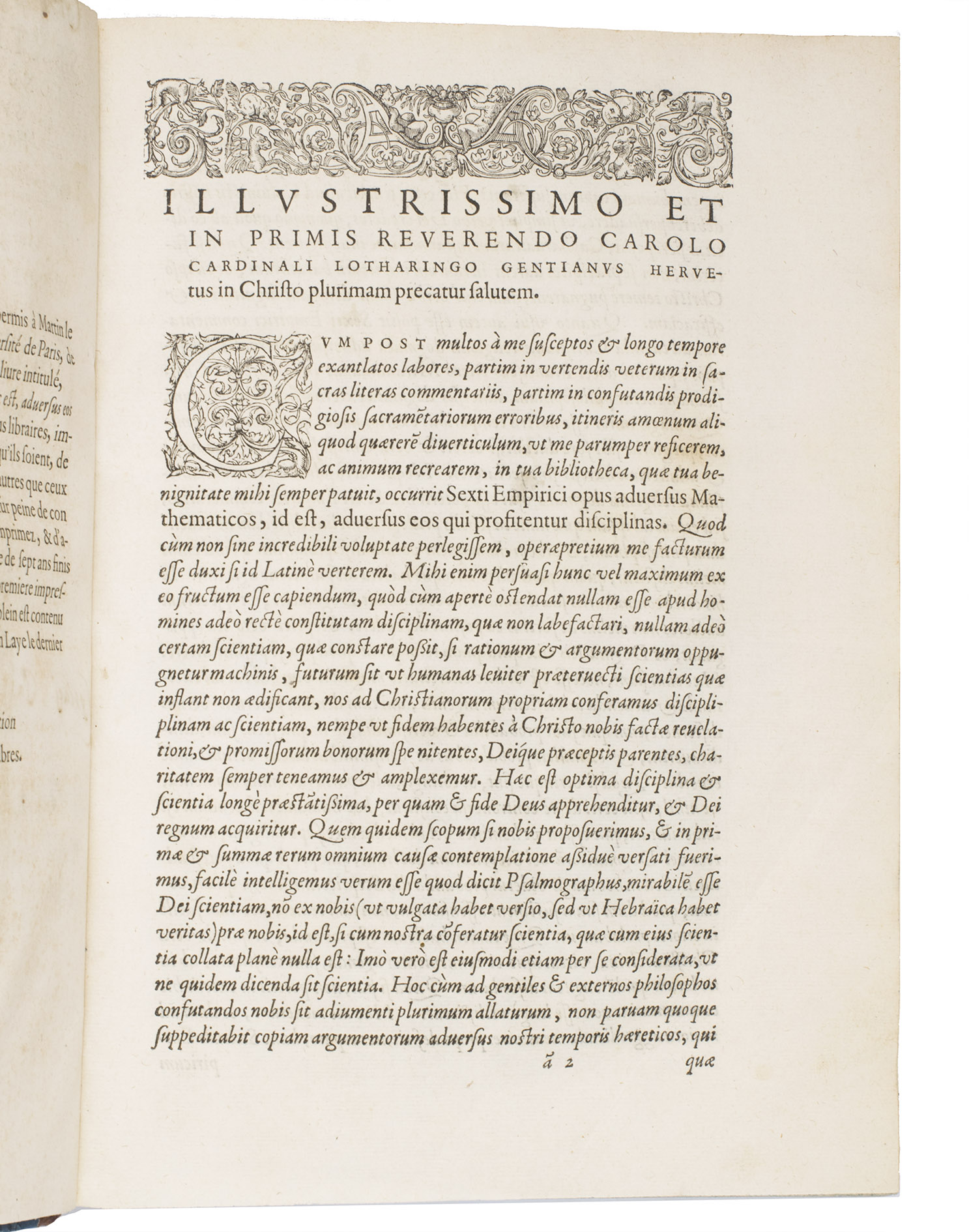
The present edition contains Latin translations of Sextus' two principal works: Adversus mathematicos (Against the Professors) and the Pyrrhoniarum hypotyposes (Outlines of Pyrrhonism). The former appears here in the first edition of the Latin translation by the French humanist and theologian Gentian Hervet (1499-1584), dedicated to Cardinal Charles de Lorraine. In his dedication Hervet presents Sextus' arguments as a powerful weapon against Calvinist doctrine. The Hypotyposes, however, was included in the Latin translation by Henri Estienne, first published separately in 1562. The original Greek text of both works was not printed until 1621.
The volume further includes a life of Pyrrho compiled from Diogenes Laërtius, as well as Erasmus' Latin translation of Galen's treatise against the Pyrrhonians (Exhortatio ad bonas artes ... de optimo docendo genere). Part of the edition was acquired by Christopher Plantin, who maintained close commercial ties with the Paris printer Martin Le Jeune, and was issued with a new title page bearing Plantin's Antwerp imprint. Copies are therefore found with either the original Paris title page or the Plantin issue.
The ownership annotations on the title page of the first part have been crossed out, several contemporary annotations and underlinings in the text, including the name of Erasmus as the translator of the Galenus text on p. 556 altered to an (illegible) other name. The spine is slightly rubbed. The head margins has been cut somewhat short, but without loss of text, the leaves are occasionally browned and foxed. Otherwise in good condition. Adams, S-1026; BM, French, p. 400; Hoffmann, III, 39495; Pettegree & Walsby, French vernacular books, 86320; USTC 158271; Voet, Plantin Press, no. 2208; cf. DSB, XII, pp. 340-341; Van der Haeghen, II, 27.
Related Subjects: