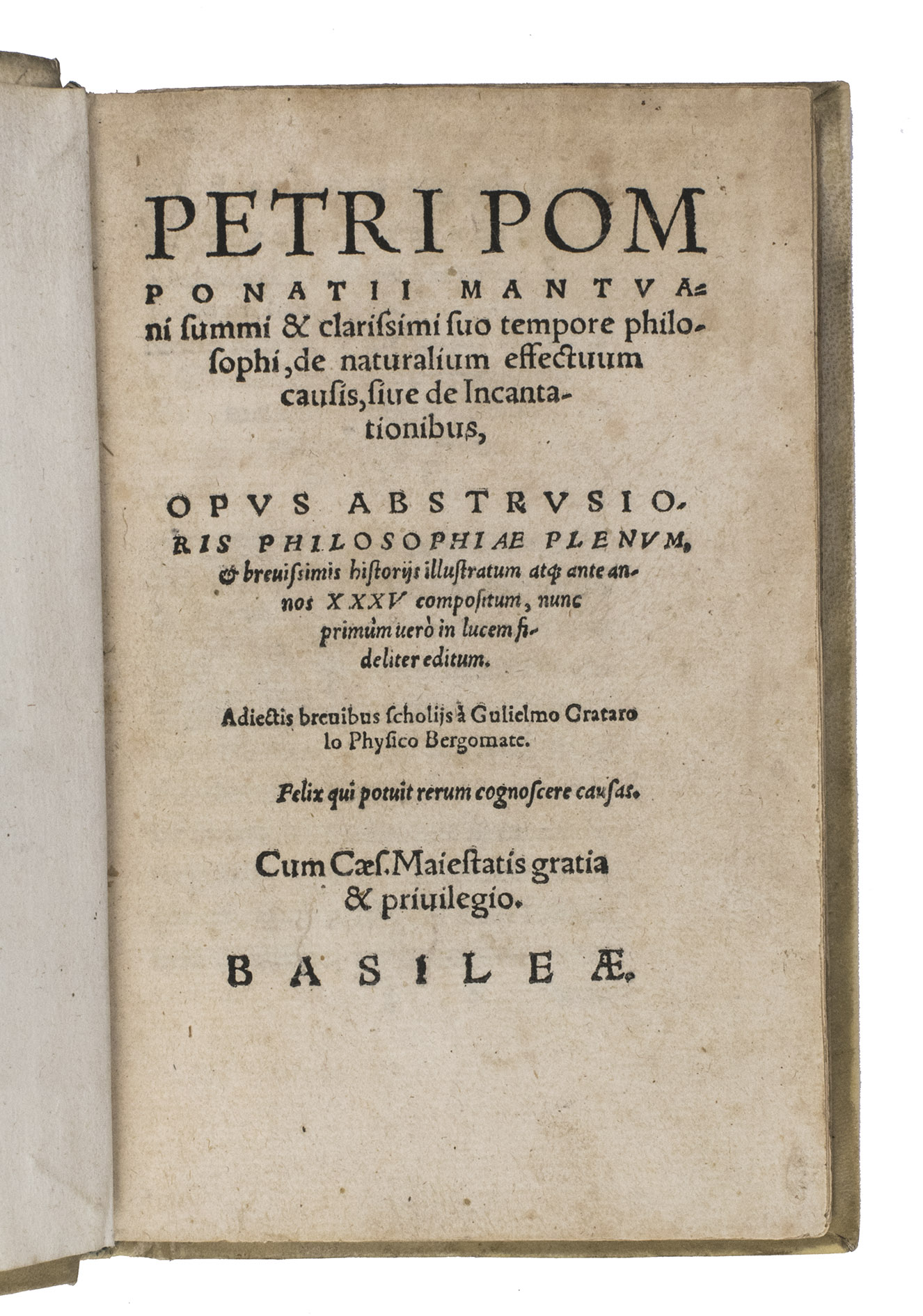
POMPONAZZI, Pietro.
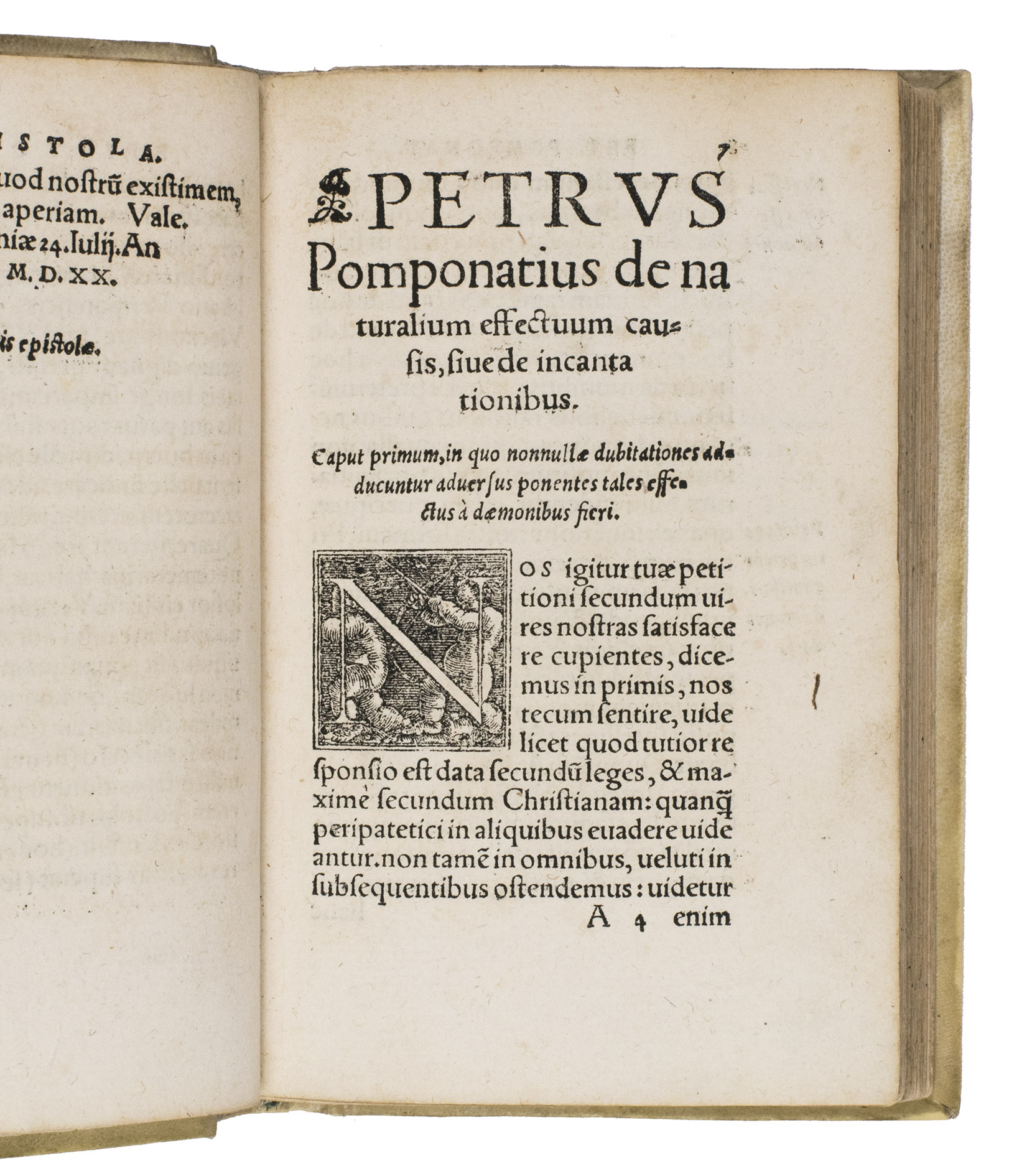
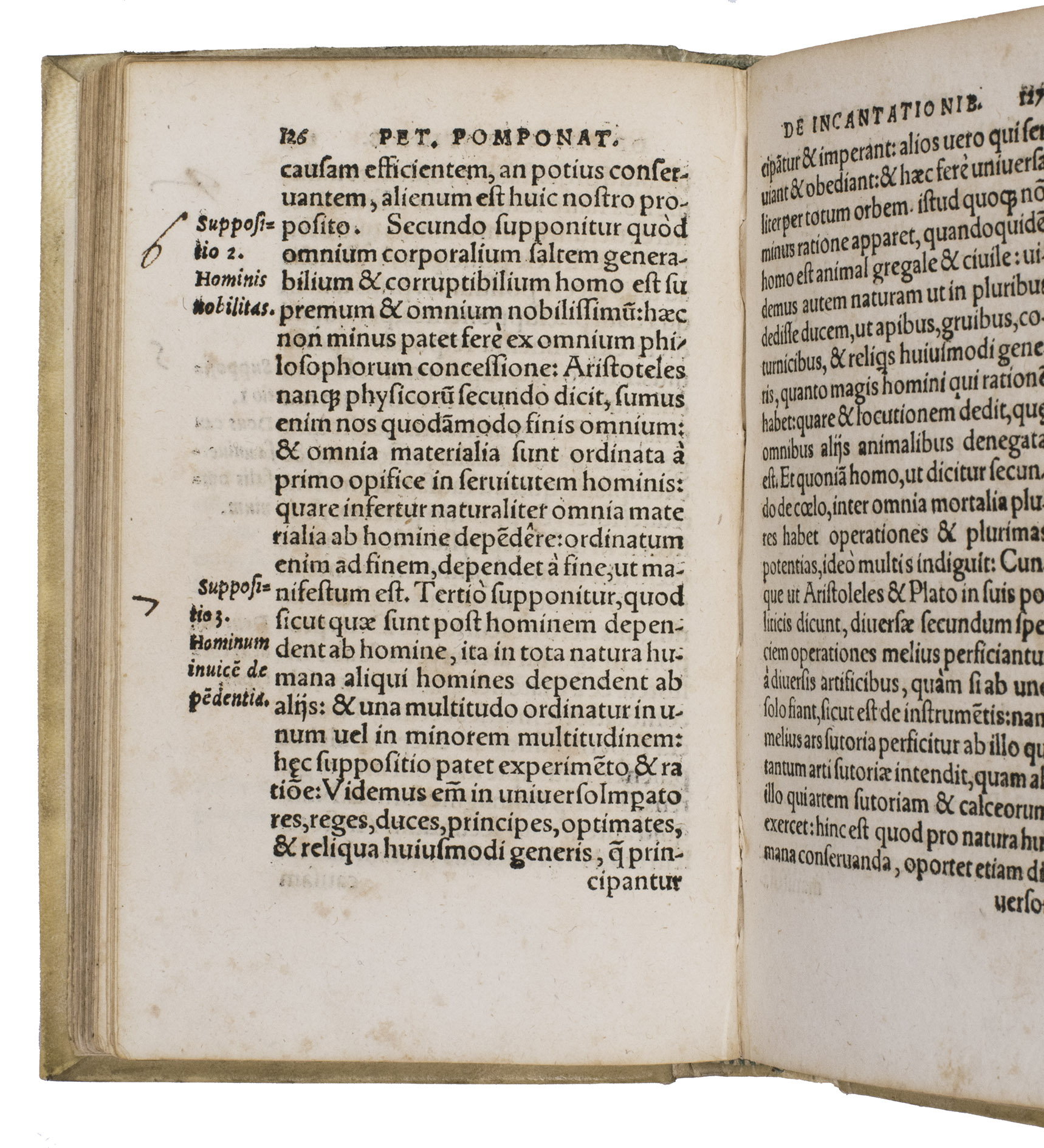
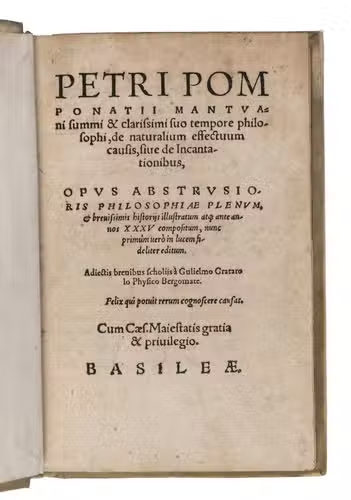
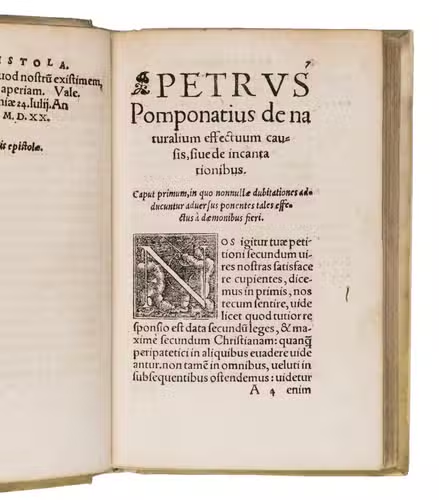
De naturalium effectuum causis, sive de incantationibus ... ante annos XXXV compositum, nunc primùm verò in lucem fideliter editum. Adiecta brevibus scholiis à Gulielmo Gratorolo Physico Bergomate.
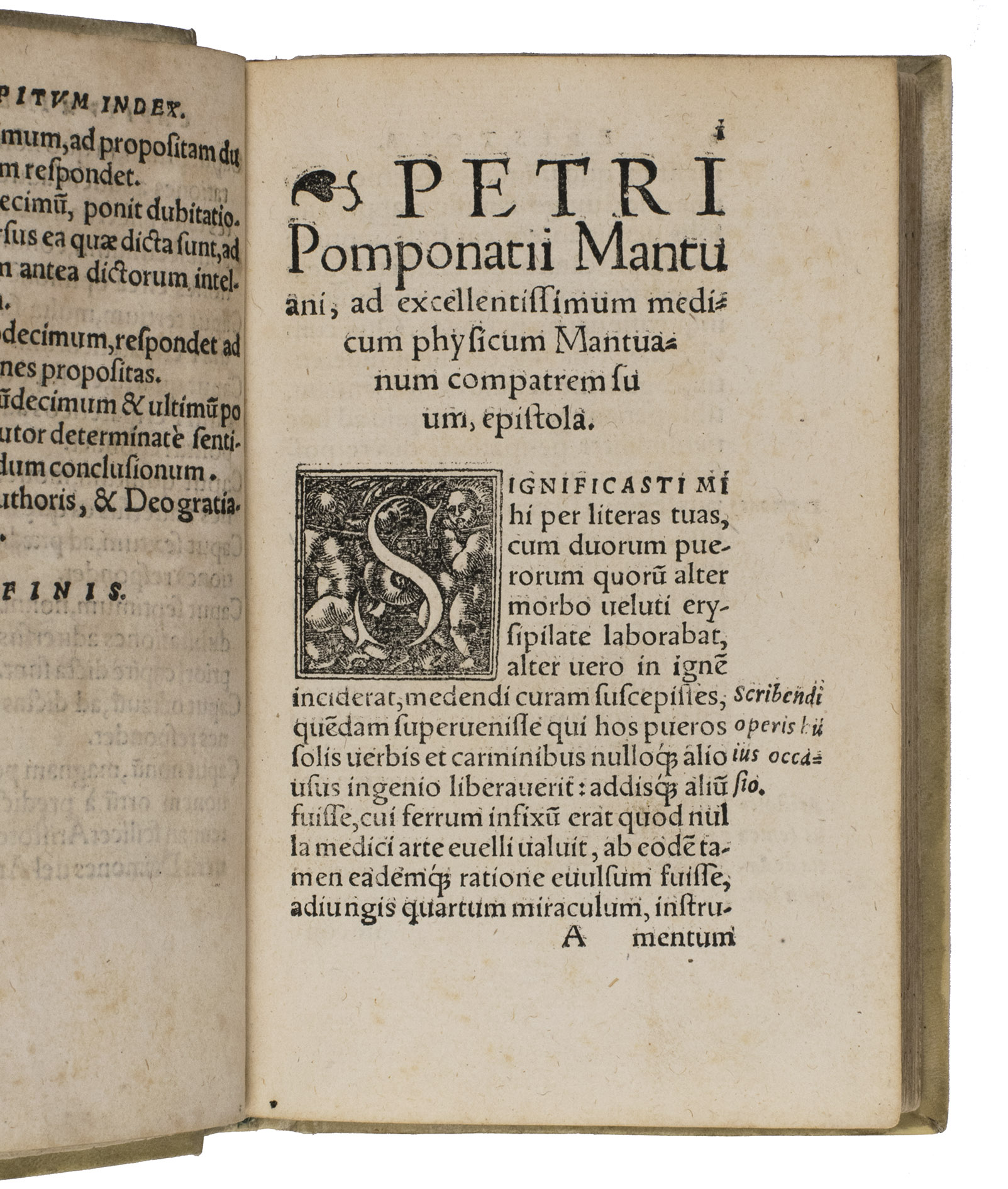
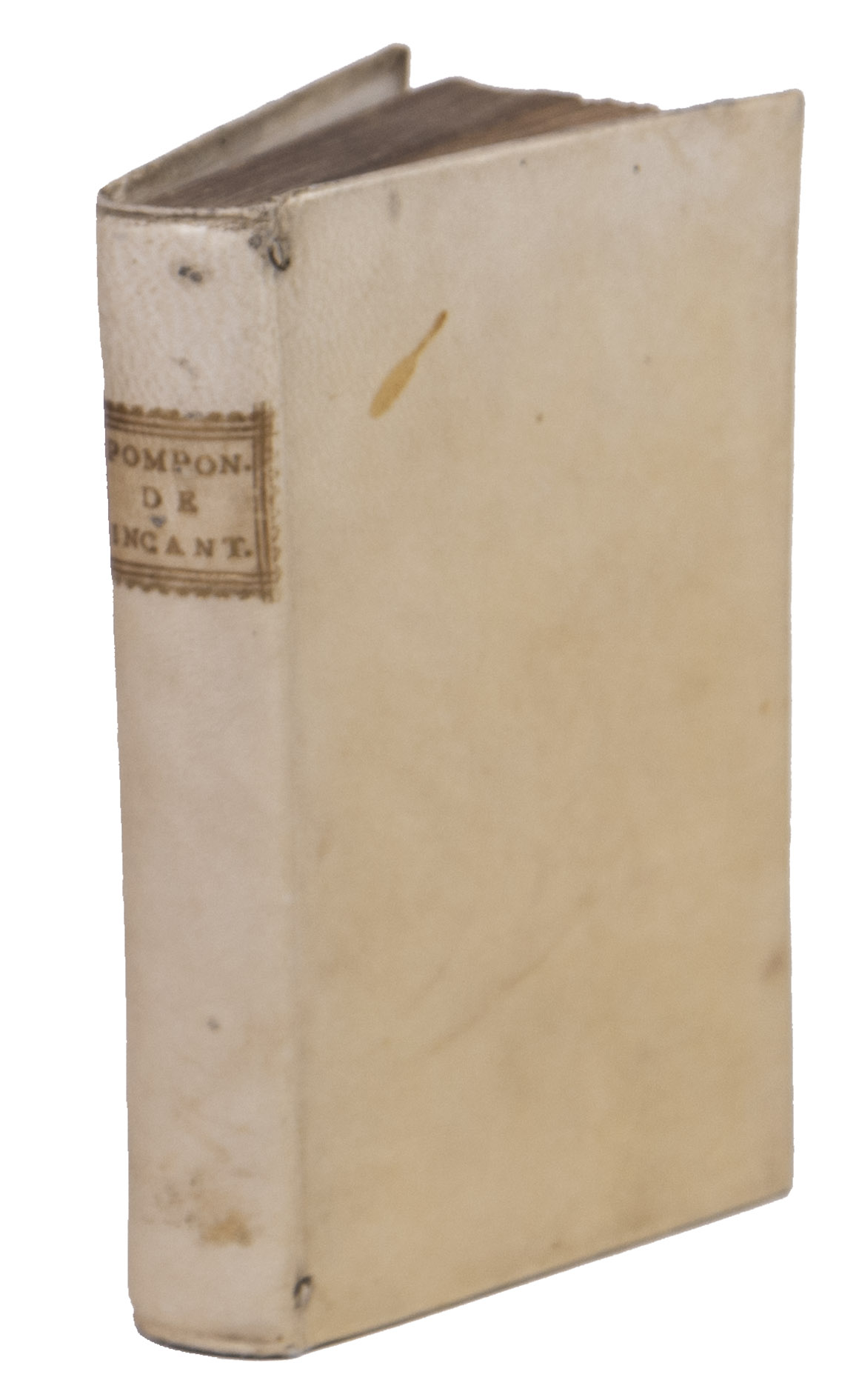
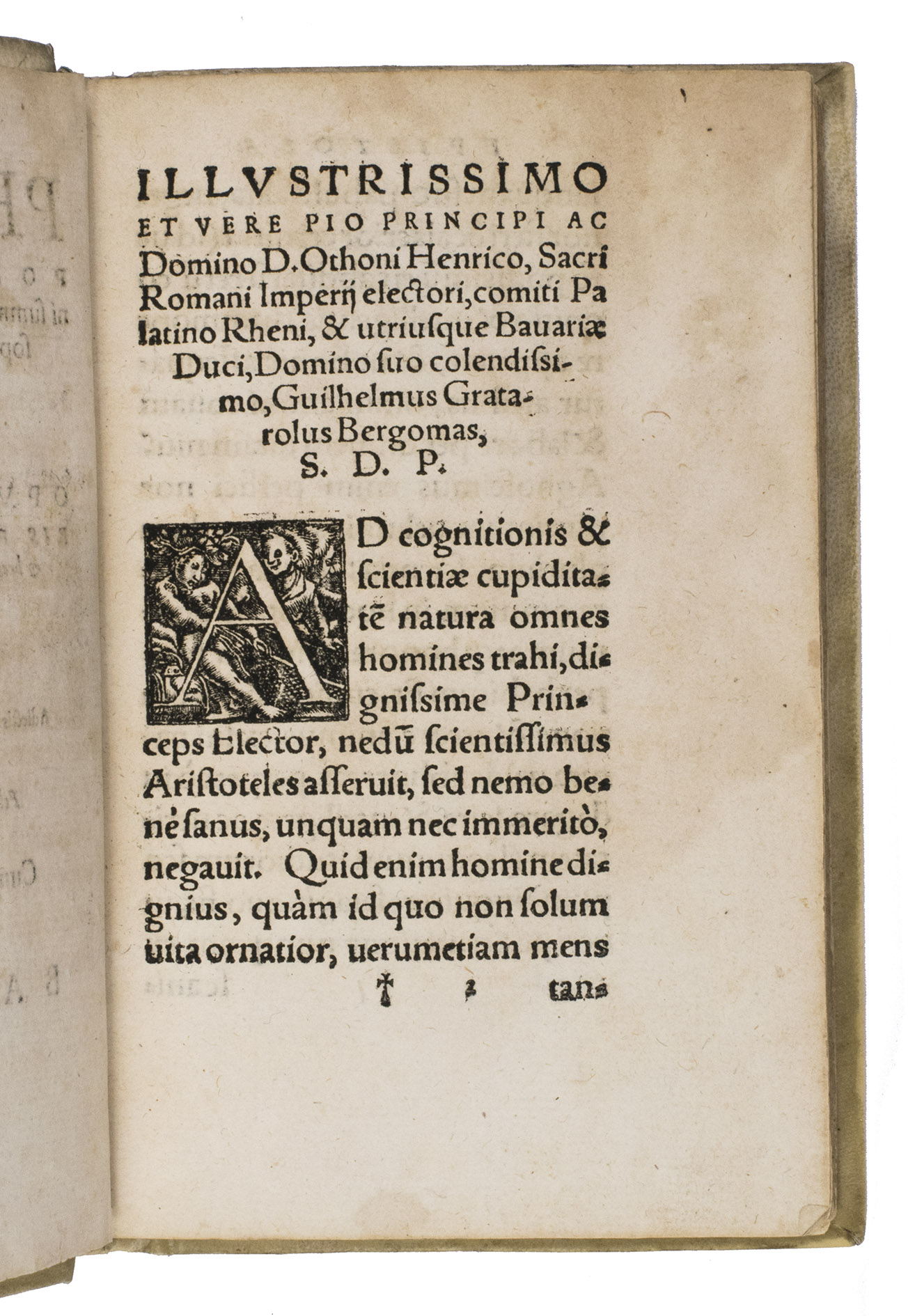
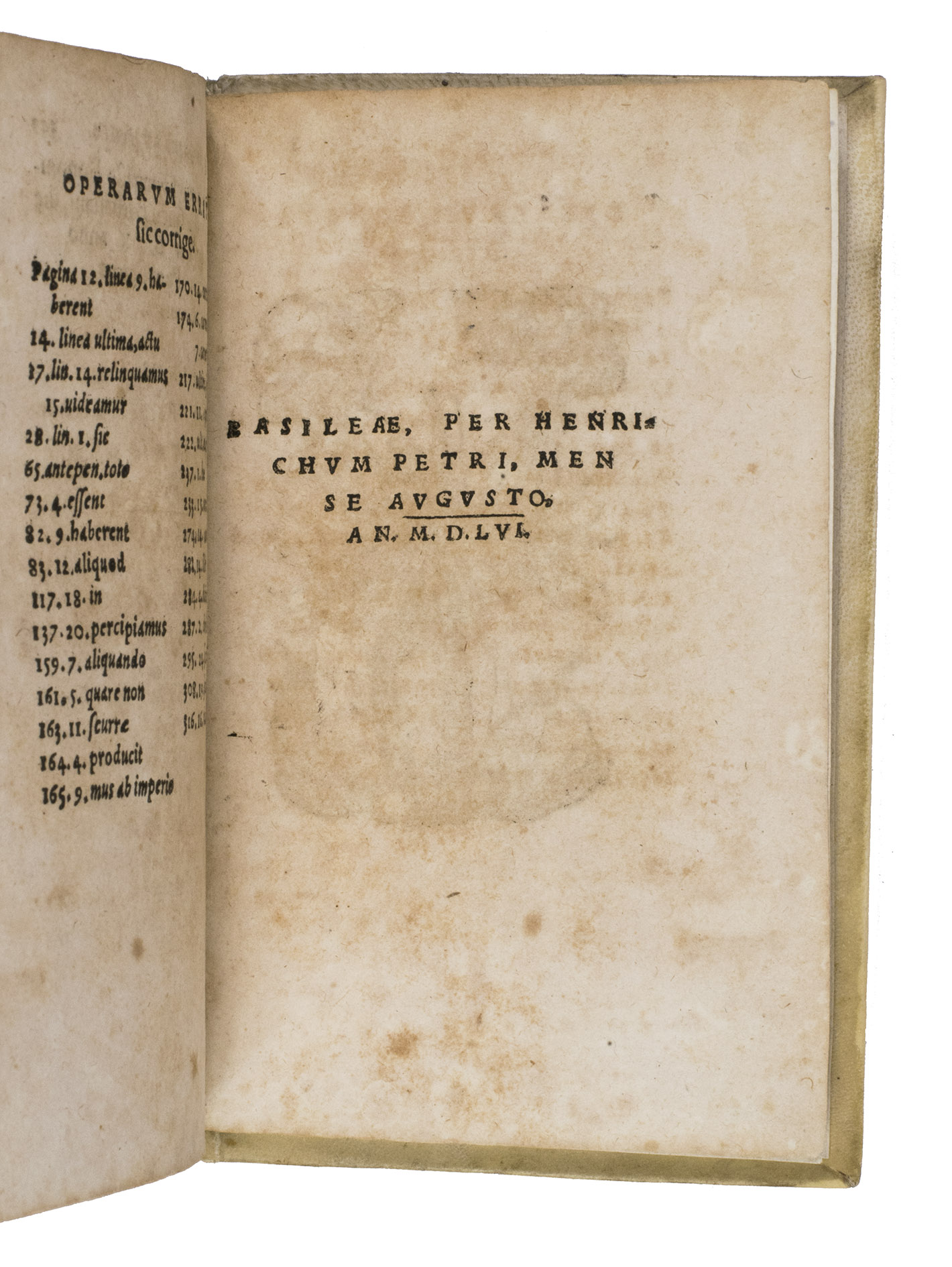
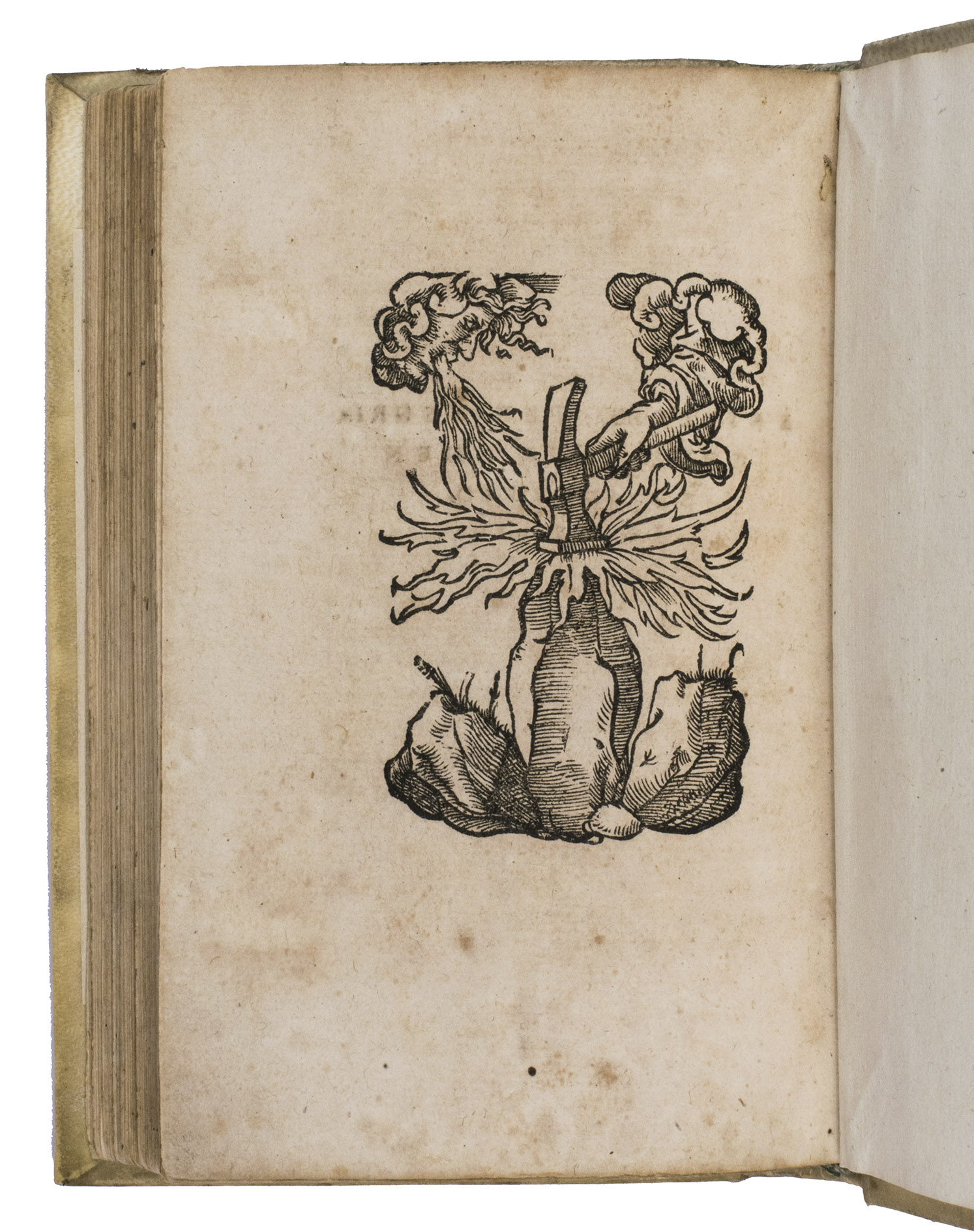
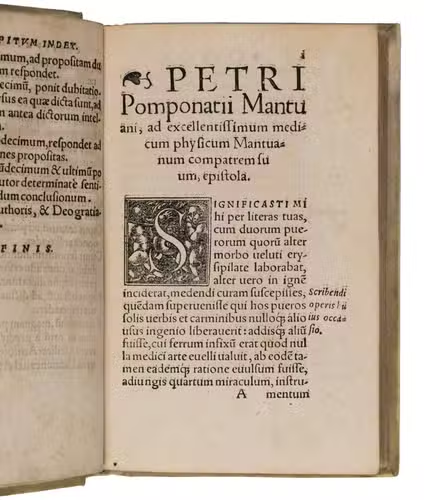
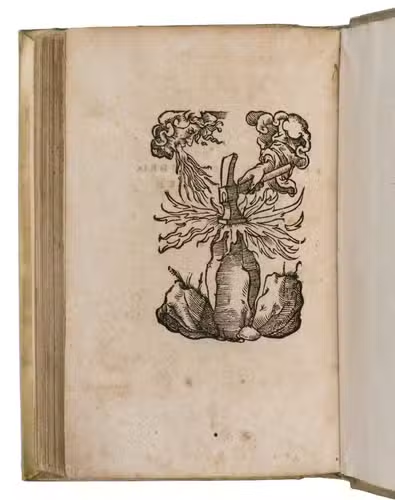
Basel, (colophon:) Heinrich Petri, August 1556. Small 8vo. With 3 decorated woodcut initials, and a woodcut printer's device at the end of the work. 17th-century vellum. [16], 349, [3] pp.
€ 15,000
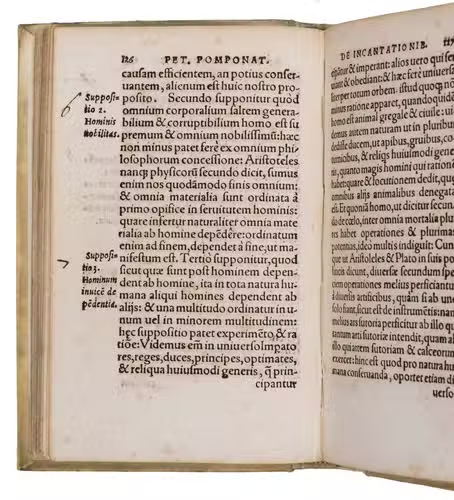
First edition of the most original work on natural philosophy of the time, treating the subject in a completely novel way, and providing the field with new methods. The work investigates seemingly miraculous events, and develops naturalistic explanations for all these occurrences, including, after some hesitation, some of the Christian miracles. "The histories of other religions record miracles similar to those of Christianity, and Pomponazzi justifies his frequent citation of historians in a philosophical work as authorities for past natural events of rare occurrence. Such is the most detailed and carefully worked out, the most plausible and at the same time most sweeping expression of the doctrine of astrological control over the history and development of religions that I have seen in any Latin author" (Thorndike). The work was quite controversial in its own time and was the only one of Pomponazzi's works to be placed on the Index.
Pietro Pomponazzi (1462-1525) was a philosopher in the Aristotelian tradition, who taught at the universities of Padua, Ferrara, and Bologna. In 1516 he produced his great work De immortalitate animae (On the immortality of the soul), in which he concludes that no natural reasons can be adduced to prove the immortality of the soul. The work was condemned and publicly burned in Venice, and Pomponazzi was accused of heresy. Possibly because of the controversy surrounding him, Pomponazzi's other great work was not published until after his death, after circulating in manuscript for over 30 years. Written in 1520 under de title De incantionibus, it was published in Basel in 1556 as De naturalium effectuum causis by Heinrich Petri.
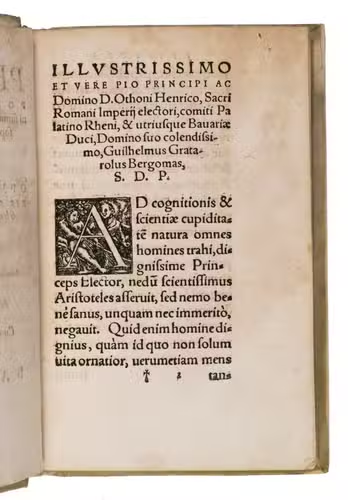
The work was brought to Basel by Guglielmo Gratarolo, who had to flee from Italy due to his anti-religious views. He wrote the preface of the present first edition, in which he defends Pomponazzi's views on the immortality of the soul and Christian miracles. "Granting, however, that there may be something in the work which does not entirely square with Christianity, Gratarolo thinks that it should not be suppressed or withheld from the scholarly public, since it contains more solid physics and abstruse philosophy than do many huge commentaries of certain authors taken together" (Thorndike).
Bringing everything in the world under the general laws of nature, the history of religion as well as all other facts in experience, the work gives us, for the first time, an outline of a philosophy of nature and of religion. With the main aim of the work being to determine the fact that there is no such thing as "supernatural", all miraculous events and powers observed in experience, or recorded in history, have their natural, scientific explanation. "[H]e brings the whole phenomena of religious history - the changes of religious belief, and the phases of thaumaturgic power - under certain universal laws of nature. Of these facts as of all others, he suggests, there is a natural and a rational explanation; in them the powers that are at work in all nature are still operative; and they are subject to the laws and conditions that govern nature generally - the laws of change, of development, of growth and decay, and transformation in decay" (Douglas, p. 299).
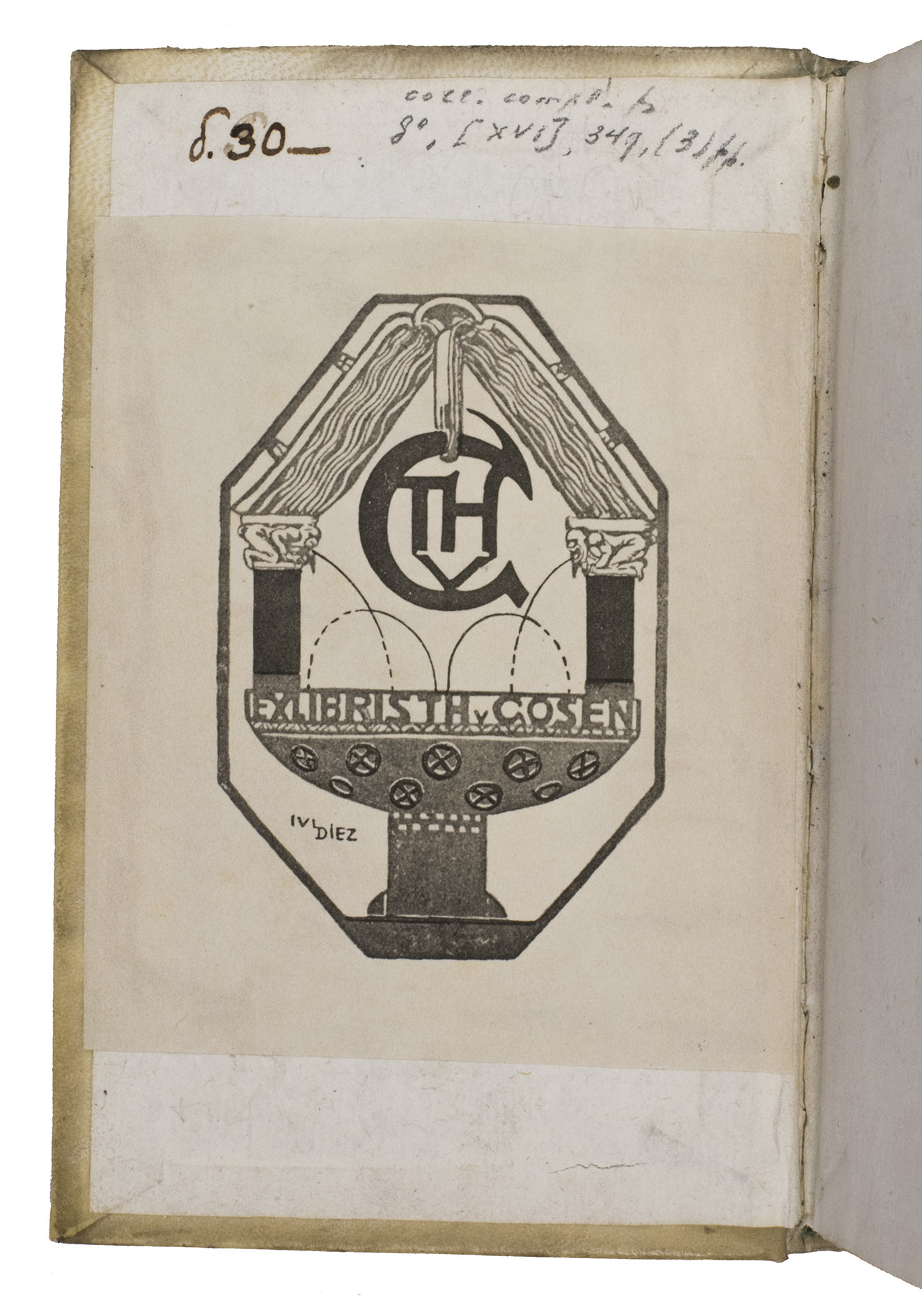
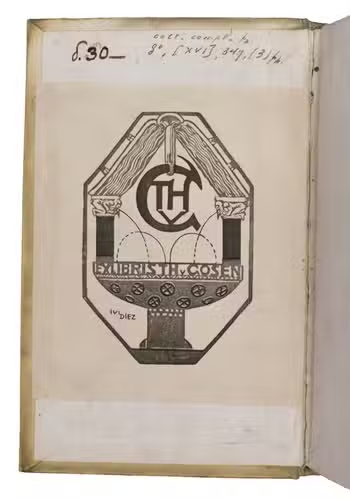
With the bookplate of Th. v. Gosen (possibly the sculptor Theodor von Gosen (1873-1943)) mounted on the front pastedown. A small brown stain on the front board. Some of the leaves are somewhat browned and foxed, the lower outer corner of page 115 has been torn off, without affecting the text. Otherwise in good condition. Adams P-1827; BM STC German, p. 710; Caillet 8819; Durling 3713; Machiels P-1095; Rosenthal, Bibl. magica 3016; USTC 683646; VD 16 P 4144; cf. Douglas, A.H., The philosophy and psychology of Pietro Pomponazzi; DSB 11, pp. 71-74; Thorndike V, pp. 94-110.
Related Subjects: